
JEWISH ZODIAC MOSAIC
About the Zodiac Mosaic Floor
In 2024, the Museum at Eldridge Street unveiled a new mosaic floor designed by Mark Podwal z"l (1945-2024), an award-winning artist whose work explores the depth and diversity of Jewish tradition. The colorful mosaic design features the 12 signs of the zodiac, each of which is paired with the first Hebrew letter of the month it is associated with according to the Hebrew calendar. The new floor, made possible by the Estate of Roger Jacques Herz, is located in the vestibule just outside of the historic Main Sanctuary.
Zodiac mosaics can be found in synagogues dating back to the Roman Empire. Archaeological researchers have excavated synagogue mosaic floors at several ancient Jewish sites, including the village of Huqoq, which is mentioned in the Hebrew Bible. Astrological imagery continued to infuse Jewish art in the medieval period, when zodiacs appeared in liturgical books and ritual objects in connection with Jewish festivals and life cycle events. In the 17th and 18th centuries, ornate painted motifs of the zodiac decorated the walls and ceilings inside wooden synagogues across the Polish-Lithuanian Commonwealth. At the turn of the 20th century, the zodiac made its way to the Lower East Side, adorning the walls of the Bialystoker Synagogue and the Stanton Street Shul, both of which are standing today. The zodiac remains a powerful motif in Jewish folk art and architecture, linking Jewish ritual and cyclical celebration with local traditions and visual cultures.
About the Jewish Zodiac Calendar
Did you know that the Jewish zodiac calendar works differently than the western astrological calendar? While western astrology uses fixed dates in the Gregorian calendar (for example, Aries always falls between March 21 and April 20), your Jewish zodiac sign depends on which Hebrew month you were born in, not the Gregorian date. Two people born on April 10 in different years might have different Jewish zodiac signs if one was born during Nisan and the other during Adar II (in a leap year).
Use the calendar converter below to find out about your sign. You might be surprised to learn that it is different than your Gregorian sign!
RESULT
Step Into Mark Podwal's Colorful Jewish Zodiac Floor







NISAN (Aries)
Nisan is the first month of the Jewish year according to the biblical cycle, and according to one tradition, the month in which the world was created. The Midrash relates Aries with the Binding of Isaac. “The fact is that God wanted to destroy the Temple in the first month. But the merit of Isaac stood forward to plead: ‘Master of the universe, remember the sacrifice for which I let myself be tied up before thee: I offered myself for the sacrifice” (Pasikta Rabbati 27-28). “And Abraham lifted up his eyes and looked, and behold, behind him was a ram, caught in a thicket by his horns” Genesis 22:13. Therefore, the bush at times depicted alongside the sign of Aries alludes to the Binding of Isaac. Here, the ram is caught with its horn on the Hebrew letter nun, Nisan’s first letter. The Midrash Pirkei d’Rebbe Eliezer (chapter 31) describes how no part of the sacrificed ram went to waste. Its ashes form the base of the Temple’s incense altar; ten of the ram’s sinews are the ten strings of King David’s harp; the ram’s hide formed the prophet Elijah’s leather belt; and its two horns shofars - the left horn heard on Mount Sinai and the right horn will be sounded in the future at the ingathering of the exiles.
IYAR (Taurus)
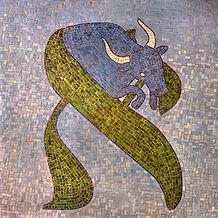
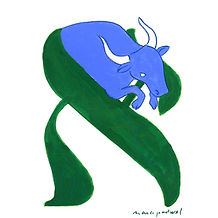
Taurus, the bull, is the zodiac sign of Iyar, and alludes to the great sin that happened that month. The Vilna Gaon writes that in Iyar, “a breach took place,” which refers to the sin of the Golden Calf causing mankind to fall from its exalted level of spirituality. Midrash Pesikta Rabbati linked Taurus to the image of Abraham. “Then God wanted to destroy the Temple in the second month. But the merit of Abraham stood forward, as it is said: ‘And Abraham ran and fetched a young bull’” to feed his three angelic guests (Genesis 18:17). Typically, only the front of the bull’s body is depicted. The initial source for this partial representation may derive from a Sumerian tale when the Bull of Heaven was killed. However, a Jewish interpretation for depicting only half the bull’s body may symbolize the biblical covenant ceremony, sealed by cutting an animal in two halves. The divided carcasses signified a similar fate for the party who breaks the covenant. In confirming his covenant with Abraham, God instructed him to bring clean animals and to cut each carcass into two pieces. And so Abraham promptly cut animals in half in his covenant as instructed by God (Genesis 15:9-10).
SIVAN (Gemini)
The month of Sivan is associated with the tribe of Zevulun, supporters of those who study the Torah. It contains the holiday of Shavuot, which commemorates the day the Israelites received the twin Tablets of the Ten Commandments at Mount Sinai. To avoid graven images of human beings, synagogue zodiac motifs traditionally depict the twins as a pair of non-human entities. In this case, Podwal uses the symbol of the twin Tablets.
TAMMUZ (Cancer)
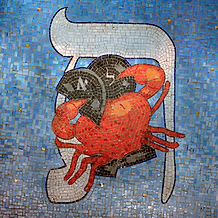
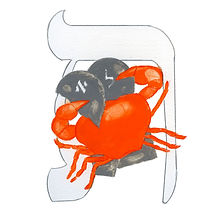
Midrash Pesikta Rabbati links the sign of cancer, the crab, with the idea of water: “The God wanted to destroy the Temple in the fourth month. But the merit of Moses stood forward to plead: The crab can only draw its life from the water and my life was drawn from the water.” The crab never walks straight to its destination. It goes in a crooked zigzag path, sideways and backwards at the same time. The Book of Proverbs advises that man should avoid the path of the crooked and follow the path of the straight who fear God. Although the crab is a weak creature its pinch is excruciatingly painful. It is the crab’s pinch that characterizes the extraordinary pain the Jewish people endured in Tammuz, a month in which there are no festivals (and a fast day).
The Zohar relates that the days of Tammuz are dangerous and the wicked reign at that time. Legend says that the first of Tammuz was the day that Adam and Eve were expelled from Eden. A midrash adds that the first of Tammuz was the day Moses struck a rock in anger trying to get water out of it, instead of speaking to it as God had ordered. As punishment for not speaking to the rock, the Holy One, blessed be He, forbade Moses from entering the Promised Land. Among the five tragic events that tradition holds took place on the seventeenth of Tammuz was the shattering of the tablets of the Ten Commandments. To memorialize these events, the seventeenth of Tammuz is observed as a minor fast day, and marks the beginning of a three-week period of mourning that lasts through Tisha B'Av, the major fast day that commemorates the destruction of both Temples.
AV (Leo)
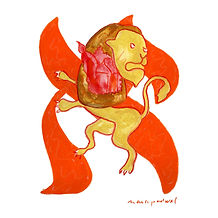
Midrash Pesikta Rabbati, explaining why the Temple was destroyed in Av, links Leo (aryeh in Hebrew) with Ariel (“Lion of God”), one of the names for Jerusalem.
According to tradition, it was determined that The 9th day of Av (Leo), a day of mourning and fasting, will be the day of the birth of the Messiah. The 9th of Av (Leo) will become the only holiday on the Hebrew calendar.
The lion is also the fifth sign (“Leo”) of the zodiac, corresponding to the fifth Hebrew month, Av. Yalkut Shimoni, a thirteenth-century midrashic anthology, states that the lion (Nebuchadnezzar, referred to in the Book of Jeremiah as a lion) came in the month of the lion (Av) and destroyed the lion (the Temple).
ELUL (Virgo)
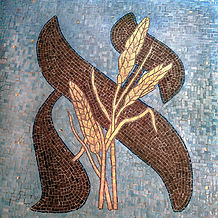
The Rabbis have interpreted the month Elul’s name as an acrostic for the verse from Song of Songs: “I am my beloved’s, and my beloved is mine.” Hence, Elul’s zodiac sign Virgo, Latin for maiden, may be considered to fittingly suit the month. Elul’s astrological maiden is often portrayed as holding flowers or wheat. Yet at times, Virgo is depicted by a cluster of wheat alone. In the Polish wooden synagogue of Chodorow, the artist illustrated the zodiac symbols within the religious restrictions forbidding the depiction of the entire human body. For example, Virgo is represented by two forearms covered in modest sleeves, with a pair of delicate hands embroidering a framed cloth with flowers, a common pastime among young women.
During Elul there are many rituals that are involved with Teshuvah, returning to God. These customs include the daily recitation of Psalm 27. A kabbalistic explanation for its recitation is that the psalm mentions God’s name 13 times, and if recited daily it will protect from an evil decree when judged by the heavenly court at this time of year. Another custom is the blowing of the shofar every weekday after services from the second of Elul until the day prior to Rosh Hashanah. It is said the blowing the shofar is to raise people's awareness and to instill fear, as per Amos 3:16, "Can a shofar be blown in the city and the people not tremble?"
TISHREI (Libra)
The month of Tishrei’s zodiac sign is Libra, a pair of scales. In Tishrei, the days and nights are in balance for they are of equal length. The sign of Libra is not restricted to only those born in this month but has implications for all mankind. In Jewish tradition, Libra’s scales are a sign in heaven that Tishrei is a time for judgment. It is in Tishrei during the High Holy Days, on Rosh Hashanah and Yom Kippur, that one’s deeds are weighed and one’s fate in the new year is determined. How the scale tips makes the decision as to “who will live, who will die, who will be rich, who will be poor.”
At times, the scales are illustrated as taut and balanced. Here, a shofar weighs down the scales. A midrash says that God told Abraham: “Thy children will sin before me in time to come, and I will sit in judgement before them on the New Year’s Day. If they should desire that I should grant them pardon, they shall blow the ram’s horn on that day, and I, mindful of the ram that was substituted for Isaac as a sacrifice, will forgive them for their sins.”
MARHESHVAN (Scorpio)
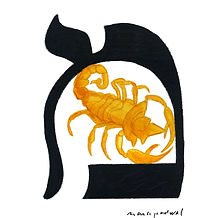
Throughout the Talmud, and many later works, the month is called Marheshvan. Yet, in the oldest extant esoteric work, Sefer Yetzirah (the Book of Formation) this month is referred to as Heshvan. The Zohar likewise calls this month Heshvan and this is how it is usually called in everyday speech. There are several explanations as to the deeper meaning behind the mar in Marheshvan. Some say that mar means “bitterness.” Among the reasons the month is seen as bitter is that it lacks any holidays coming right after the holiday-rich month of Tishrei. Moreover, Heshvan is also considered bitter because it marks the beginning of the rainy season in Israel. Marheshvan’s zodiac sign is Scorpio, the scorpion.
Since those living in Northern Europe had never seen a scorpion, it was often drawn as a lizard, turtle, or dragon. Whereas the Talmud states that of all the languages in the world Greek is the most suited for the translation of the Torah, Genesis Rabbah refers to Greece as a scorpion. Leviticus Rabbah notes of the Greek commanders, governors, and generals: “Just as the scorpion produces eggs sixty at a time, so the Kingdom of Greece would set up its administration in groups of sixty.” On their shields, Greek soldiers painted the image of a scorpion to frighten their enemies. Hence Scorpio’s sign is depicted as a scorpion wearing a Greek helmet.
KISLEV (Sagittarius)
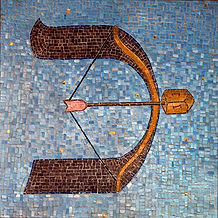
The traditional zodiac sign of Saggitarius is a centaur, a half human, and half horse mythological creature, holding a bow and arrow. In Judaism, the sign of Saggitarius corresponds to the winter month of Kislev. Ancient Israel synagogue mosaic floors show Saggitarius either as a centaur archer or human archer. To avoid the depiction of a human or mythological figure, medieval Jewish prayer books simply represented the sign with a bow and arrow as did ceiling paintings of Eastern European wooden synagogues. Kislev’s bow also has been imagined as a rainbow since the first rainbow after the Flood appeared in Kislev.
The Midrash says that Haman studied astrology to determine what month would be the optimum time for his plan to destroy the Jewish people. (Esther Rabbah 7:11) When he studied the sign of Kislev, he learned about the blessing Jacob, before his death, gave to Joseph that “his bow remained firm.” (Genesis 49:24) Learning that Kislev’s zodiac sign held the power of Joseph’s bow, Haman looked for a different month.
Kislev is often referred to as the “Month of Miracles” for its holiday Hanukkah commemorates the miraculous victory of the small Jewish army over the mighty Syrian-Greek empire. Moreover, Hanukkah celebrates the miracle of the oil. When after the war, the Jews sought to light the Temple menorah they found only one small jug of pure oil. Miraculously, the one-day supply burned for eight days. And so, the sages instituted the eight-day festival of Hanukkah. Symbolizing the holiday is an arrowhead in the shape of a dreidel, a four-sided spinning top played during the festival.
TEVET (Capricorn)
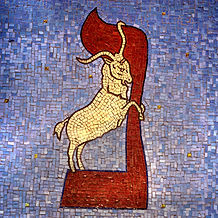
Tevet’s zodiac sign Capricorn is usually portrayed as a mythological animal with the body of a goat and tail of a fish. Depictions of Capricorn as a sea goat appeared in Jewish art during the Roman period as on the Hammat Tiberius synagogue mosaic floor. Sea goats are mentioned in Jewish stories that tell of how one day all the creatures of the sea must offer themselves to the huge monster Leviathan. An account tells of a sailor who came upon a sea goat while far at sea. On its horns was carved the sentence, translated as "I am a little sea-animal, yet I traversed three hundred parasangs to offer myself as food to the Leviathan." Yet, the most common Jewish representation of Capricorn was that of a male goat or kid.
In Judaism, Capricorn was named “the slain kid,” which refers to the blood of the lamb sacrificed during the Passover story, saving firstborns from slaughter. Capricorn was also known as Azazel, the scapegoat described in Leviticus. Whereas Tevet is considered one of the three negative months of the year with Tammuz and Av, thanks to the festival of Hanukkah, which extends itself to the first two days of Tevet, there is an infusion of light that offers sustenance throughout the month. The Rebbe of Ruzhhin teaches, that what a simple man can accomplish on the eighth day of Hanukkah, even great Tzadikkim cannot accomplish with their prayers. On Rosh Hashanah we are judged, on Yom Kippur the judgement is sealed, and on Shemini Atzeret it is delivered. Yet there is still one chance to change things until the eighth day on Hanukkah, after which everything is completed and the decrees start to get carried out.
SHEVAT (Aquarius)
The zodiac sign Aquarius associated with the Hebrew month Shevat is a pail or water bucket. In secular astrology, the symbol is not the bucket but the carrier. According to Ibn Ezra, one of the most distinguished Jewish biblical commentators and philosophers of the Middle Ages, Aquarius is the sign of the Jewish people. The 19th-century Hasidic text Bnei Yissachar says: “Just as the bucket is the servant of the water, Israel is the servant of the Torah.” Tu B’Shevat is a Jewish holiday occurring on the 15th day of Shevat, also called “The New Year for Trees.” Legend claims that on Tu B’Shevat the trees embrace, kiss, and wish one another a happy new year. On Tu B'Shevat, it is the custom to increase the amounts of fruits eaten, especially fruits mentioned in the Torah associated with the Holy Land: grapes: figs, pomegranates, olives, and dates.
A Kabbalistic seder was introduced in Safed during the sixteenth century in which fifteen varieties of fruits are eaten as a spiritual repair for the sin of Adam and Eve who ate the forbidden fruit in the Garden of Eden. Jews plant trees on this day or collect money towards planting trees in Israel. For hundreds of years, rabbis have taught how important trees are. According to the Midrash Sifre, “If not for the trees, human life could not exist.” Rabbi Yochanan ben Zakkai used to say, “If you have a sapling in your hand and you are told that the Messiah has come, first plant the sapling and then go and welcome the Messiah.” Hence, the appropriateness of a water bucket being the month’s zodiac sign.
ADAR (Pisces)
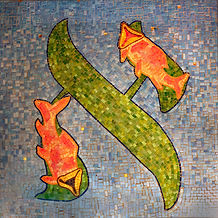
It is written in the Talmud that “When Adar comes, joy is increased.” The month’s joy is primarily due to the presence within the month of the holiday Purim. Adar’s zodiac sign is Pisces – two fish swimming in opposite directions. Midrash Esther Rabbah recounts that wicked Haman studied the signs of the zodiac and cast lots to determine which month Israel would be the most vulnerable to be destroyed. When the lot fell in the month Adar, Haman confidently rejoiced knowing that Moses died that month. And so, Haman believed Adar would be a propitious month for his destructive plot.
Noting that Adar’s sign is Pisces, Haman asserted: “Just as fish swallow one another, I will swallow them.” Yet, Haman was unaware that Moses’s birthday was the exact same day. Because Moses was born in Adar and lived 120 years to the exact same date, this month was lucky for the Jews. Consequently, Haman’s plot failed. Haman’s other miscalculation was his belief that the sign of Pisces was favorable for his plot. Jewish tradition teaches that fish symbolize good fortune and protection from evil. The Talmud claims that fish are resistant from the Evil Eye because they are covered by the sea, thus out of sight from the eyes of man. Moreover, fish are the only animals to have survived the Flood.
During a Jewish leap year, there are two Adars. It is the first Adar that has the zodiac sign of fish. The question is what is the zodiac sign for the second Adar? The answer suggests that the reason that the Hebrew word for fish, dagim, is plural rather than singular dag is because it can represent both months. Others say that the second Adar does not have a zodiac sign.